
Tuesday night (Dec 12-13) Emma had a long, restless night. She hardly slept and showed signs of difficulty breathing… really shallow inhales and rapid exhales. Mark, Erin and Emma were up all night.
SMA affects the muscles for breathing as well as the muscles for moving the arms and legs.
From a paper, Respiratory Care of SMA and Choices provided by Cure SMA and written by Mary Schroth, MD – University of Wisconsin Children’s Hospital…
“The muscles important for breathing include the intercostal muscles and the diaphragm. The intercostal muscles are the muscles between the ribs. These muscles help to lift up and expand the shape of the rib cage thereby helping the lungs to inflate. The diaphragm is the large muscle at the bottom of the rib cage. The diaphragm works by pulling the rib cage down in an almost opposite direction of the intercostal muscles, and also helps the chest wall and lungs to expand causing air to fill the lungs. What you see in someone without SMA is that the ribcage inflates with air at the top of the ribcage as well as at the bottom of the ribcage during inhalation.
“SMA causes very weak intercostals muscles, the muscles between the ribs. The strongest breathing muscle in SMA is the diaphragm. As a result, children with SMA type I and type II appear to breath with their stomach muscles. The belly or abdomen pooches out while they take a breath in. The top of the rib cage does not appear to move. In infants less than a year of age, the rib cage is very soft even though it consists of the ribs, which are bones and cartilage. Over time the rib cage may appear as though the bottom of the ribcage is pulled down. This gives the appearance of a bell shaped chest meaning that the top of the chest is narrow and the bottom of the chest is much wider. Sometimes the area of the sternum or the bone in the front that the ribs attach to becomes sunken. This is called pectus excavatum and happens because the intercostals muscles are not strong enough to help pull the top of the rib cage out against the diaphragm that is pulling down.
“During sleep, the muscles relax including the muscles for breathing. During normal breathing, we breathe in oxygen and exhale carbon dioxide. When someone who has muscle weakness falls asleep, their muscles for breathing also relax and their breaths become more shallow. Sometimes those breaths become so shallow that they do not inhale adequate oxygen and they also do not exhale enough carbon dioxide. This is called hypoventilation. As a result, their oxygen saturations during sleep may drop to less than 94% and their carbon dioxide level may increase.”
So Wednesday morning Erin checked with Dr. Alexis who referred Emma for sleep study at Seattle Children’s Hospital. The sleep clinic had a late cancellation that very day and so Emma was off with her overnight bag to her night in the sleep study lab. There was room for only a single parent so Erin took Emma (with help from her support team – Grandma Kathy).
After checking in at 6:30 pm, the lab techs put about 20 different monitoring leads on Emma’s face, head, hands, chest and feet .
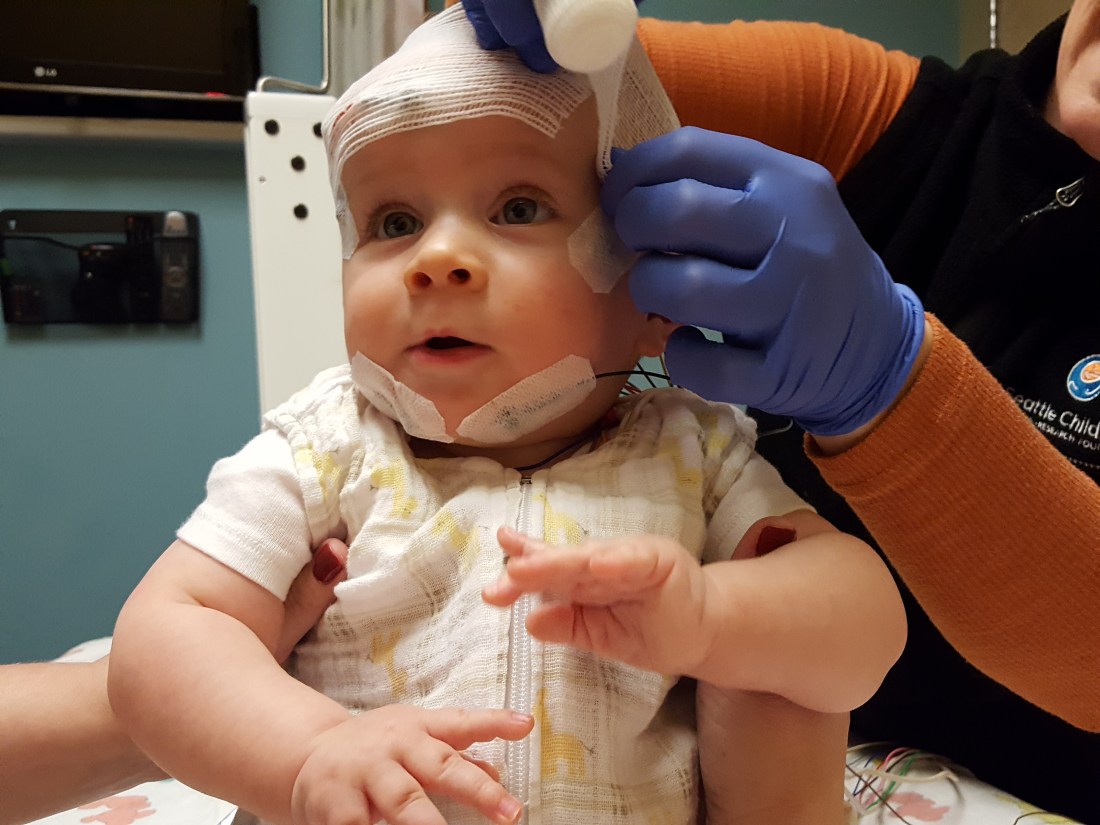 Wow!
Wow!
The techs were very quick and were extremely impressed with Emma’s smiley reactions.
For some strange reason, she seemed to actually enjoy the experience.
Unfortunately, the leads on her chin were JUST out of reach of Emma’s best efforts at licking them off.
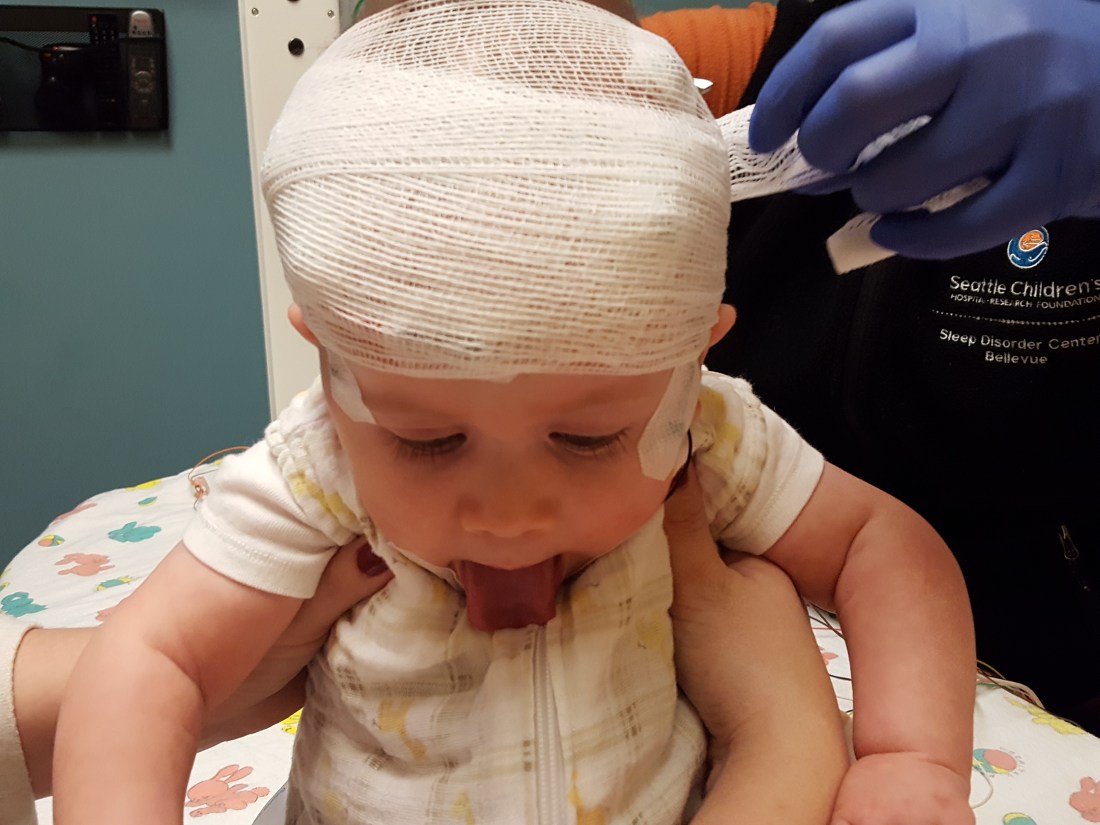 Darn it! Missed again!
Finally all the leads were connected and she was ready to go!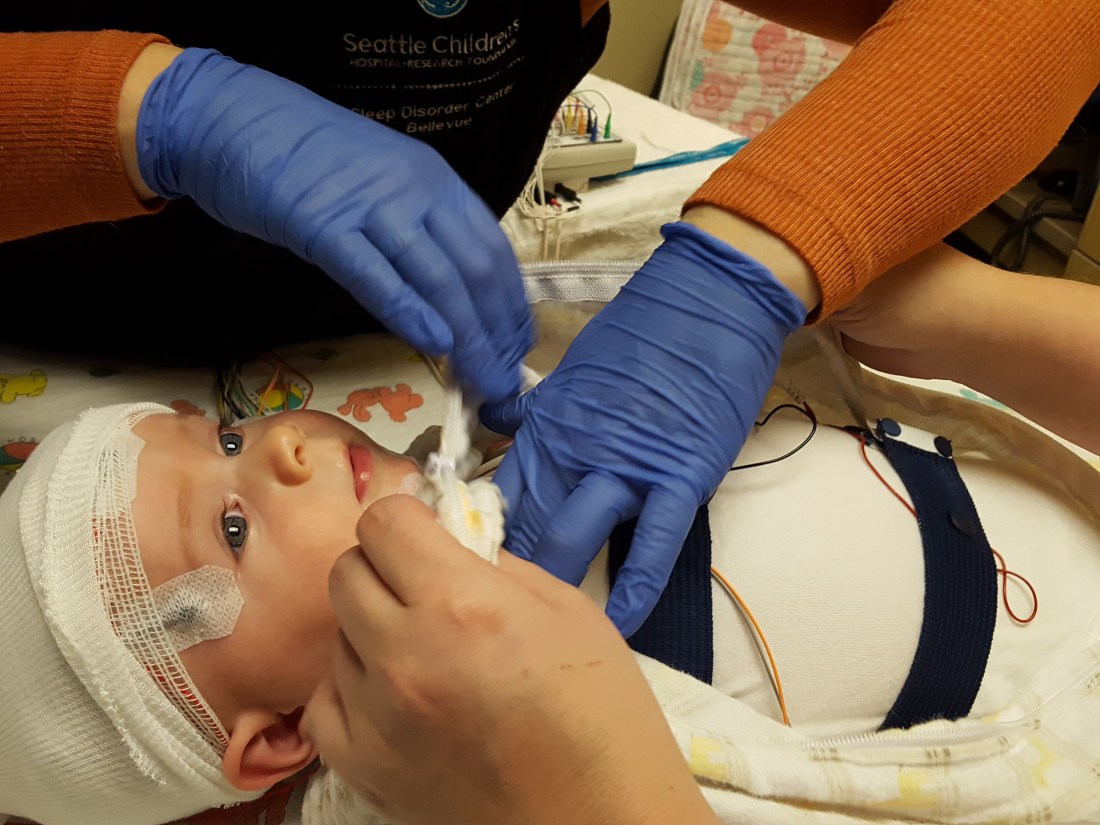
 Can you believe all this attention I’m getting?
Then it was lights out and time for all good little Emmas to go to sleep….
Right away…
… hmm, OK… maybe after a bit.
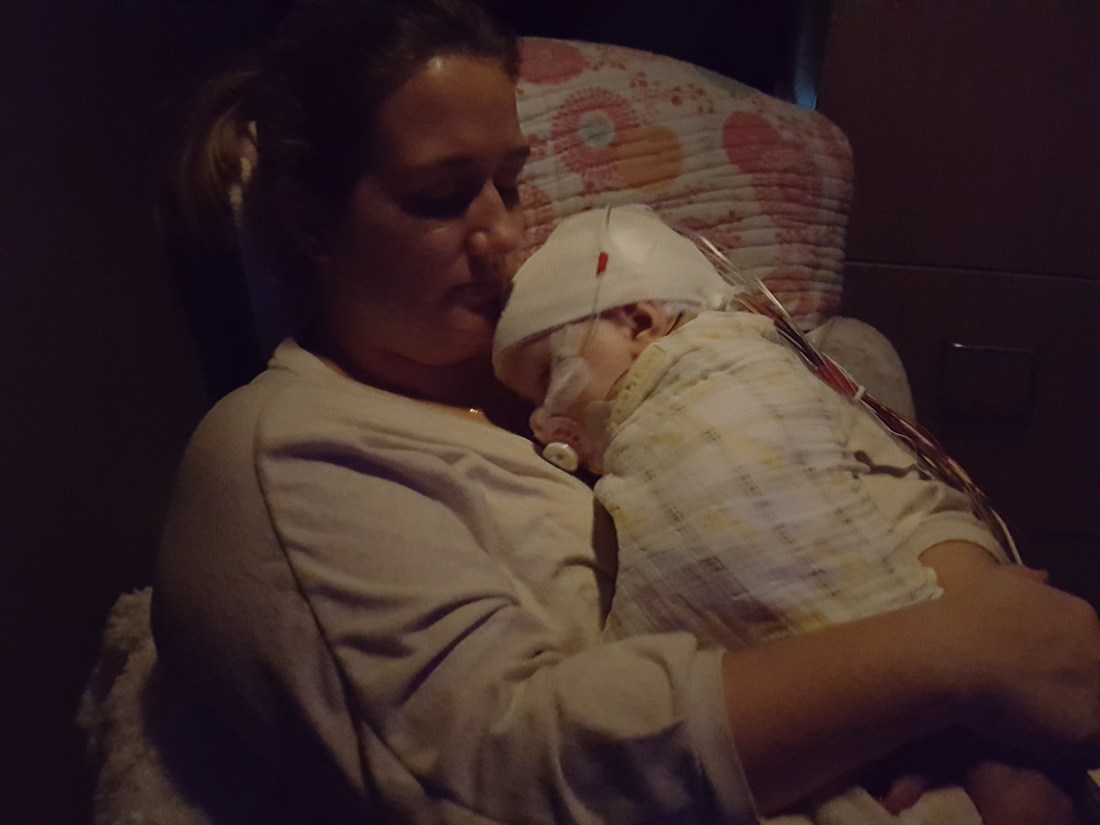
Finally, at around 10:30 pm, she drifted off.
She woke up every 45 minutes or so over the next few hours, then finally slept until about 6:00 am.
Then Grandma showed up again to fix Emma’s hairdo.
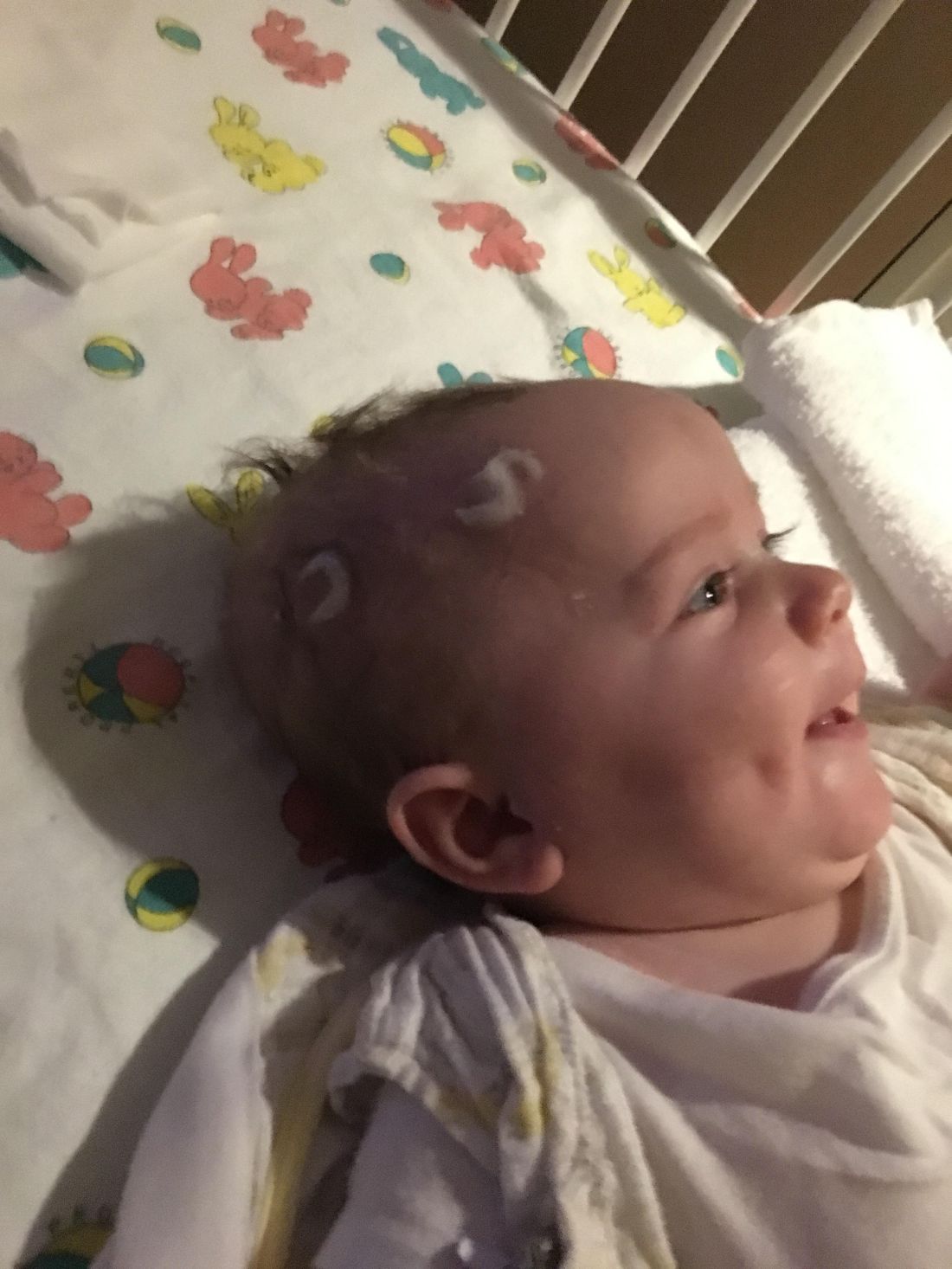
YAY! It’s Grandma Kathy! Look what they did to my hair!
We were told she was the best “behaved” baby there that night and cried the least. No trophies or prize money, but we’ll take it!
The Results
Emma demonstrated disrupted oxygen an average of 8.8 times per hour. At times her O2 level dropped as low as 72%. Typical babies experience 1 or less disruptions per hour – but some SMA Type 1 babies are up to 40 times an hour. So we aren’t at a critically urgent point yet. However, Emma is considered moderate and so we are moving quickly.
Emma will be fitted for her own BiPAP Friday morning and we should receive it within a day or so.
From the same source as cited above…
“BiPAP refers to bilevel or two level positive airway pressure. This is usually delivered through a mask over the nose. BiPAP provides a higher pressure and volume of air into the lungs during inhalation and inflates the lung greater than what the person can do without the BiPAP machine. During exhalation, the BiPAP pressure drops so that air can passively leave the lungs. The BiPAP machine can sense when the person is taking a breath and gives the breath in synchrony with the individual. A respiratory rate is also set so that the BiPAP gives a minimum number of breaths per minute. The person can breath above that rate and the BiPAP will deliver more breaths.”
Emma is in the 98% percentile for head size so we shouldn’t experience a common problem for babies of the mask being too big. It will take a few weeks for Emma to get used to it (probably longer for Mom and Dad) but then she should sleep at night for nice long stretches….
Mark and Erin have heard rumors of 9-11 hours of uninterrupted sleep!
That may be wishful thinking… but stay tuned.

 EmmaStrong2017
Even covered in leafs, Emma is still adorable. Fingers crossed this helps improve her (and Mom and Dad’s) sleep!
LikeLike
Oops… i meant ‘leads’ not ‘leafs’
LikeLike
Yeah, well you should see Emma all covered in LEAFS! Even cuter! (But NOT Toronto Maple Leafs)
LikeLike
She wins everyone’s hearts again! Hang in there Mom, Dad, Grandma and Grandpa, you’re doing a great job. Just keep following Emma’s lead, we are all learning from her.
LikeLike
You are such a good little baby Emma!!
Thank you for all of these updates “grandpa Jerry”. It really helps us stay connected with Emma’s journey.
LikeLike
You’re very welcome, “grand-Auntie” Darlene. Give our best to all your family.
LikeLike